Fast Facts
Location:
Kanwar Nagar
Timings:
9:00 AM to 5:00 PM
Entry Fees:
Indian- INR 100
Foreigner-INR 400
Video camera- INR 200
Guide- INR 300
Royal Grandeur tour- INR 2500
Overview
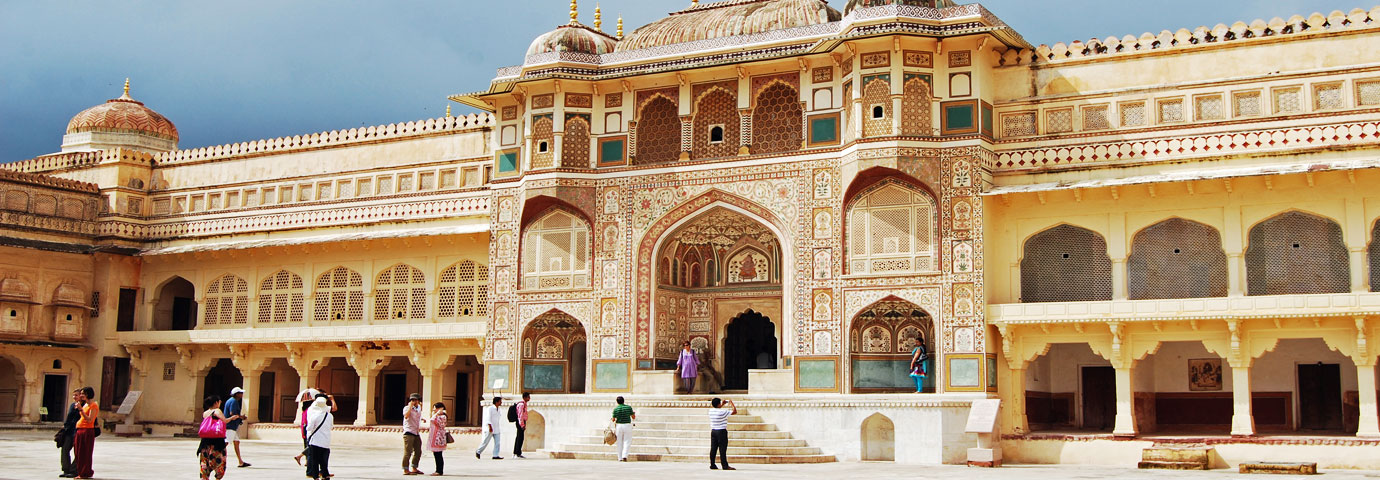
Popular as the Pink City, Jaipur is one of the major attractions of the Indian state of Rajasthan. Founded by Maharaja Sawaii Jai Singh II in 1727, it is majorly known for its age-old attractions presenting the picture of a remarkable past. One of the most important places of interest in Jaipur is City Palace which boasts of a beautiful blend of Rajput, European and Mughal styles of construction. The palace in a way depicts the rich and royal history of the city.
There is a big complex inside the majestic building which constitutes of several other palaces, halls, holy shrines, gardens and multiple gateways. The Palace is considered to be the residence of the royal family.
History and Legend
City Palace, Jaipur was constructed between 1729 and 1732. It paints the picture of the rich culture and heritage of the state.
Sawaii Jai Singh II commissioned the work of this palace, especially the exterior walls of this grand building. He moved to the city of Jaipur from Amber due to increase in population and water shortage problems. Further, he called-up a Bengali architect Vidhyadhar Bhattacharya who designed the palace complex according to the Vastushastra. The beautifully designed palace is still well-preserved and is listed among the prime attractions of the state.
Architecture
The City Palace complex comprises of various palaces, pavilions, temples and gardens. There are a number of gateways that provide entry to the palace complex such as Virendra Pol, Udai Pol and Tripolia Gate (triple gate). Virendra Pol and Udai Pol are open for public, but Tripoia Pol is for royal family only.
The essential highlights of the City Palace in Jaipur are Chandra Mahal, Mubarak Mahal, Mukut Mahal, Maharani's Palace, Shri Govind Dev ji Temple and the City Palace Museum.
Inside the City Palace in Jaipur
Mubarak Mahal
Mubarak Mahal is a reception center built by Maharaja Madho Singh II in late 19th century. The Mahal marks a great combination of Islamic, Rajput and European architecture. Now, the section is developed as a museum which exhibits a rich display of variety of textiles including royal garments, embroidered shawls, Kashmiri Pashminas, Sanganeri block prints and silk sarees. There is also set of clothes that were 1.2 meters wide and weighed 250 kilograms, worn by Sawai Madhosingh I.
Chandra Mahal
Chandra Mahal is a seven storied building which has particular names for each floor namely Sukh-Niwas, Ranga-Mandir, Pitam-Niwas, Chabi-Niwas, Shri-Niwas and Mukut-Mandir or Mukut Mahal. At the entrance, there is a beautiful peacock gate which has balconies and a pavilion at the roof from where one can observe a panoramic view of the city. It is the major segment of the palace that comprises of amazing paintings, floral decorations and mirror work on walls.
Most of Chandra Niwas or Chandra Mahal is the residence of descendents of the rulers of Jaipur, only ground floor is open for public which has a museum that exhibits articles used by royal family such as carpets and manuscripts.
Hall of Rest or Sukh Nivas constitutes of a drawing room and a dining hall which is attractively decorated with Mughal paintings and glass and silver dining table. Another is, Hall of Beauty or Shobha Niwas on the 4th floor that has decorative mirror walls and tiles ornamented with mica and gold.
Hall of Images or Chavi Nivas is the fifth floor of the Chandra Mahal that was the rest place of Maharaja during rainy season.
Lastly, at the top of Mahal, a flag was hoisted when the Maharaja was inside and when he went away, the flag of queen was unfurled.
Pritam Niwas Chowk
Pritam Niwas Chowk is the inner-courtyard compartment that has four gates that depict the themes related to four seasons and Hindu Gods. The four gates are- Northwest Peacock gate- with pattern of peacocks on the door symbolizing the autmn season and is dedicated to Lord Vishnu, Southwest Lotus Gate- with flower and petal pattern indicating summer season and is dedicated to Lord Shiva and Parvati Northwest Green gate or Leheriya gate- painted in green color suggestive of spring and is dedicated to Lord Ganesha and Rose gate- with flower pattern signifying the winter season and is dedicated to Goddess Devi.
Diwan-I-Khas
Diwan-I-Khas is a marble ornamented chamber that was used as a private audience hall of Maharajas. There are two big silver vessels with a height of 1.6 meters holding a capacity up to 4000 liters. The vessels were prepared by melting 14000 silver coins without soldering. The weight of these vessels is 340 kilogram.
These vessels have listed their names in the Guinness book of world record as the World’s Largest Silver Vessels. Sawaii Madho Singh II was a highly devoted Hindu; he used to carry water of the Ganges to drink on his trip to England in 1901 because he did not want to drink English water. The notable vessels are now known as Gangajelies. The section also has eye-catching crystal chandeliers hanging, which are covered with plastic and are unveiled only on special occasions.
Diwan-I-Aam
Referred as the hall of public audience or Sabha Niwas, Diwan-I-Aam is a hall which has bright ceilings furnished in red and gold colors. The hall displays an art gallery that has exquisite miniature paintings of Rajasthani, Mughal and Persian art, ancient texts, embroidered rugs, Kashmir shawls and carpets.
There is also a Golden throne which is called as Takth-e-Rawal, the seat of Maharaja when with public. The seat of Maharaja was carried out on elephants or palanquin bearers during his visit outside the palace. At the entrance of the palace there are two elephants made of marble rock are on display.
Maharani Palace
As the name suggests, the Maharani Palace is the residence of the queens of the royal family. Now, the palace is transformed into a museum that is repository to the weapons which were used during the war. The striking ceilings of the palace are festooned with unique frescoes. There are weapons such as scissor action digger and swords attached with pistols
Bhaggi Khana
Bhaggi Khana is a museum which has a collection of old carriages, palanquins and Europeans cabs often used as Baggis. There is a Victoria Baggi which was gifted to Maharaja by Prince of Whales in 1876; Mahadol, a palanquin with a single bamboo bar used to take priests and a chariot or ratha to carry Hindu Gods during festivals.
GovindDev Ji Temple
A holy shrine dedicated to Hindu god Lord Krishna. The Govind Dev ji temple was constructed in 18th century and has European chandeliers and paintings of Indian art. The high ceilings of the temple are decorated in gold.